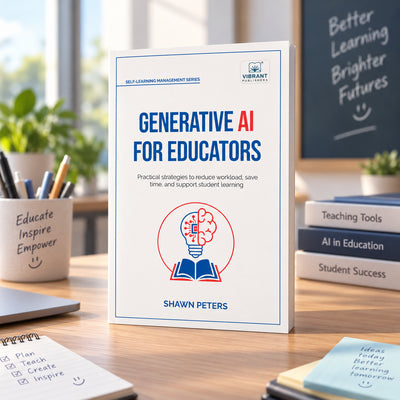

Generative AI for Educators

Generative AI for Educators

Practical Strategies to Reduce Workload, Save Time, and Support Student Learning

★★★★★ (4.8/5) Rated by 1,200+ Readers
$30.00 List Price: $60.00 SAVE 50%

Frequently bought together

Complete your learning with these related titles

Buy 3 at the price of 2

🏷 Get 1 Book Free
This bookGenerative AI for Educators
Generative AI for Educators
$30.00 $60.00

Description

Are you looking for practical ways to use generative AI to reduce your workload without compromising the quality of your teaching?

Generative AI for Educators: Practical Strategies to Reduce Workload, Save Time, and Support Student Learning is a practical guide for middle school and high school teachers who want to use generative AI responsibly and effectively in the classroom. Written in clear, accessible language, it focuses on classroom-ready strategies that help educators save time while keeping professional judgment at the center of every decision.

You'll discover how generative AI can support lesson and unit planning, classroom materials, assessments, rubrics, feedback, differentiation, communication, and everyday administrative tasks. The book also explores responsible AI use, including student privacy, data protection, bias, accessibility, transparency, and academic integrity.

Inside the book, you'll learn how to:

  • Reduce teacher workload by streamlining planning, assessments, feedback, and communication
  • Create AI-assisted teaching resources through effective prompting and evaluation
  • Protect student privacy and use AI responsibly
  • Build sustainable classroom workflows with downloadable templates, checklists, and prompt libraries

Written by veteran educator, curriculum developer, programmer, and author Shawn Peters, the book includes chapter summaries, Food for Thought reflections, Try This! activities, classroom case studies, and downloadable resources to help you confidently apply each concept.

Bibliographic Details

Pages: 301 pages

Paperback (ISBN): 9781636517582

eBook (ISBN): 9781636517605

Hardback (Color): 9781636517599

Category: Business & Economics

Author: Shawn Peters, Vibrant Publishers

Generative AI for Educators
Table of Contents

Chapter 1 - Teacher Workload and the Hope of AI Support

1.1 The Reality of Teacher Workload and Burnout
1.2 What Generative AI Can and Can’t Do Well
1.3 AI as a Support Tool, Not a Replacement
1.4 Setting Realistic Expectations for Time Savings

Chapter Summary
Food for Thought
Try This!

Chapter 2 - Responsible AI Use: Ethics, Privacy, and Professional Duty

2.1 Why Ethics and Privacy Must Come First
2.2 Understanding Student Data and Digital Footprints
2.3 Anonymization and Data Minimization Strategies
2.4 Bias, Equity, and Accessibility
2.5 The Importance of Transparency

Chapter Summary
Food for Thought
Try This!

Chapter 3 - Generative AI Basics for Educators

3.1 What Is Generative AI?
3.2 How AI Generates Responses
3.3 Prompting as a Professional Skill
3.4 Where Generative AI Commonly Fails
3.5 Verifying and Refining AI Output
3.6 Choosing Appropriate Tools

Chapter Summary
Food for Thought
Try This!

Chapter 4 - Streamlining Unit Planning with Generative AI

4.1 Starting from Standards and Learning Objectives
4.2 Using AI to Brainstorm Unit Themes and Big Ideas
4.3 Adapting Units for Different Grade Levels or Time Frames
4.4 Revising and Improving Existing Units
4.5 Maintaining Teacher Voice and Professional Judgment

Chapter Summary
Food for Thought
Try This!

Chapter 5 - Using AI to Produce Classroom-Ready Content

5.1 Generating Worksheets, Handouts, and Practice Activities
5.2 Creating Slide Decks and Instructional Materials
5.3 Producing Exemplars and Model Responses
5.4 Generating Reading Passages and Scenarios
5.5 Copyright, Attribution, and Content Ownership

Chapter Summary
Food for Thought
Try This!

Case Study - Using Targeted Prompting to Address Student Misconceptions

Chapter 6 - Creating Assessments and Rubrics Faster with AI

6.1 Turning Learning Objectives into Assessments
6.2 Designing Quizzes, Tests, and Performance Tasks
6.3 Creating Clear, Student-Friendly Rubrics
6.4 Adapting Assessments for Diverse Learners
6.5 Reviewing AI-Generated Assessments

Chapter Summary
Food for Thought
Try This!

Chapter 7 - Supporting Feedback and Grading with Generative AI

7.1 Supporting Consistency and Fairness in Grading
7.2 Feedback: Time-Consuming but Essential
7.3 Creating Comment Banks with AI
7.4 Academic Integrity and AI-Aware Grading Practices
7.5 What Feedback Decisions Must Remain Human

Chapter Summary
Food for Thought
Try This!

Case Study - Using a Comment Bank to Streamline Feedback

Chapter 8 - Using AI to Support Diverse Learners

8.1 Expanding Instructional Options with AI
8.2 Accommodations and Accessibility Supports
8.3 Creating Leveled Texts and Scaffolded Activities
8.4 Supporting English Language Learners (ELLs)
8.5 Enrichment and Extension Activities
8.6 Ethical Boundaries in Personalized Learning

Chapter Summary
Food for Thought
Try This!

Chapter 9 - Reducing Non-Instructional Administrative Tasks

9.1 Identifying High-Time, Low-Judgment Tasks
9.2 Drafting Professional Emails and Communications
9.3 Writing Reports, Summaries, and Documentation
9.4 Scheduling, Planning, and Organizational Support
9.5 Maintaining Professional Tone and Accountability

Chapter Summary
Food for Thought
Try This!

Chapter 10 - Making AI a Reliable, Ethical Part of Teaching Practice

10.1 Creating Sustainable AI Workflows Through Prompt Reuse
10.2 Documenting and Disclosing AI Use
10.3 Establishing Classroom Norms for AI
10.4 Staying Current with AI Policy and Tools
10.5 Long-Term Sustainability

Chapter Summary
Food for Thought
Try This!

Author

Shawn Peters has 19 years of teaching experience, is certified in Python Programming Teaching from the College of the North Atlantic, and also specializes in JavaScript and Java.

Vibrant Publishers is focused on presenting the best texts for learning about technology and business as well as books for test preparation. Categories include programming, operating systems and other texts focused on IT. In addition, a series of books helps professionals in their own disciplines learn the business skills needed in their professional growth.

Vibrant Publishers has a standardized test preparation series covering the GMAT, GRE and SAT, providing ample study and practice material in a simple and well organized format, helping students get closer to their dream universities.

Series

The Self-Learning Management Series is designed to help students, new managers, career switchers, and entrepreneurs learn essential management lessons and covers every aspect of business, from HR to Finance to Marketing to Operations across any and every industry. Each book includes basic fundamentals, important concepts, and standard and well-known principles as well as practical ways of application of the subject matter.

Editorial Reviews

Teaching in the modern classroom often feels like a constant race against the clock, with administrative duties and lesson preparation threatening to swallow up energy that belongs with students. This practical and refreshing guide demystifies cutting-edge technology, transforming it from an intimidating buzzword into a dependable assistant that gives time back to educators. Rather than promoting tech for its own sake, it grounds every recommendation in real-world pedagogy, demonstrating how smart tools can serve as a powerful co-pilot without ever replacing human judgment and heart.

It is an empowering, highly practical read that offers an actionable blueprint for any educator looking to reduce burnout, reclaim their free time, and keep their focus squarely on inspiring students.
-- Darya Yegorina, NetGalley Reviewer

I found Shawn Peters' Generative AI for Educators well-written, compelling, well thought through, informative, and on target. The book will help you leverage AI to streamline your pedagogical and administrative tasks with confidence.
-- Stephen DeVoy, Educator, Writer, AI Developer, and Software Engineer

Generative AI for Educators is well-suited for educators with limited AI knowledge. The language is accessible and avoids unnecessary technical complexity. The book addresses highly relevant issues, including teacher workload, burnout, and responsible AI adoption in education. The topics covered in the book also align well with current educational challenges.
-- Satish K., Software Engineer

Peters clearly outlines the best practices for Generative AI in education, reinforcing throughout that GenAI is a support tool—not a replacement—with the educator firmly in charge. Beyond comprehensive explanations and potential uses, the actionable prompts and revisions make this book both an informative guide and a practical workbook.
-- Brenda Hunt, BA, BMus, BEd, MEd; Retired Public School Teacher; AI Consultant

Supplemental Resources
  • 5 stars: 18 (72%)
  • 4 stars: 7 (28%)
  • 3 stars: 0 (0%)
  • 2 stars: 0 (0%)
  • 1 star: 0 (0%)
C
Courtney Delgado (Connecticut)
Must Read Guide for Sustainable Teaching

Delivers realistic, classroom tested ways to reclaim planning time without compromising instructional quality.

A
Alyssa Morales (Nevada)
Bridges Classroom Reality With Emerging Tools

Focuses on durable teaching principles rather than fleeting software trends so the strategies stay useful.

B
Brett Callahan (Maryland)
Valuable Playbook for Curriculum Coordinators

Gives instructional coaches a shared vocabulary and ethical framework for supporting faculty adoption.

N
Nathaniel Cross (Missouri)
Clear Layout and Easy to Reference Quickly

Clean formatting, well structured prompt libraries, and downloadable templates make it a book I keep open on my desk.

T
Tessa Van Der Berg (Wisconsin)
Streamlines Quiz and Worksheet Creation

Generating tiered comprehension questions and answer keys now takes a fraction of my Sunday prep.

G
Garrett Boone (Indiana)
Honest Look at Where AI Helps and Where It Fails

Appreciated the candid discussion of hallucinations, bias, and why teacher oversight remains irreplaceable.

S
Samantha Caldwell (Tennessee)
Practical Support for New and Veteran Teachers

Whether you are building your first curriculum map or refreshing seasoned units, the workflows fit right in.

A
Austin Pellegrini (New Jersey)
Useful Exemplars for Unit and Lesson Design

The before and after prompt examples show exactly how to refine vague outputs into classroom ready lessons.

K
Kelsey Brennan (Michigan)
Solid Guidance on Student Privacy Protections

Explains what never to paste into public tools and how to model responsible digital habits for students.

J
Jordan Whitaker (Arizona)
Turns AI Overwhelm Into Simple Routines

Instead of chasing dozens of new tools, this book focuses on repeatable prompting habits that work.

M
Melissa Donovan (Florida)
Essential Desk Reference for Modern Classrooms

Practical, ethical, and laser focused on reducing burnout while supporting genuine student learning.

O
Owen Fitzpatrick (Pennsylvania)
Engaging Format With Actionable Exercises

Short chapter summaries and Food for Thought prompts make it easy to read between classes.

C
Claire Beaumont (Oregon)
Clear Checklists That Prevent Common Mistakes

The verification checklists and classroom case studies make policy conversations with administrators much smoother.

R
Rachel Goldstein (New York)
Well Organized From Foundations to Assessment

Moves logically from basic AI literacy to unit planning, slide creation, and formative checks.

Z
Zachary Bennett (Colorado)
Immediate Impact on Weekly Administrative Load

Parent communication drafts, syllabus outlines, and checklist templates alone paid for the book.

G
Gregory Vance (Virginia)
Thoughtful Reflections on Bias and Verification

Reminds educators to verify outputs and watch for blind spots before bringing AI generated content into class.

N
Natalie Brooks (California)
Smart Workflows for Rubrics and Feedback

The rubric building and draft feedback strategies saved hours during essay grading week while keeping my voice intact.

D
Devon Kowalski (Illinois)
Demystifies Prompting Without Technical Fluff

Even colleagues who felt hesitant about AI found the step by step examples approachable and practical.

L
Lauren McAllister (Washington)
Great Resource for School Professional Development

Our department used the Try This exercises during a workshop and everyone left with usable materials.

M
Marcus Bennett (North Carolina)
Strong Balance of Efficiency and Pedagogy

Keeps human judgment at the center of teaching while automating repetitive administrative tasks.

H
Hannah Gallagher (Massachusetts)
Helpful Approach to Differentiation and Scaffolding

Showed me how to adapt reading passages and practice activities for different learning levels in minutes.

B
Brianna Okafor (Georgia)
Ready to Use Templates for Busy Teachers

Having prompt libraries and rubric workflows organized by teaching task makes this easy to apply immediately.

T
Trevor Lindholm (Minnesota)
Grounded Advice From a Working Educator

You can tell this was written by someone who understands real bell schedules, grading piles, and diverse classrooms.

C
Caleb Henderson (Ohio)
Clear Guardrails for Responsible Classroom AI

The chapters on student privacy, data minimization, and academic honesty give teachers confidence without jargon.

M
Megan Holloway (Texas)
Practical Guide That Actually Saves Prep Time

Shawn Peters breaks down classroom prompting into clear steps that cut my weekly lesson planning in half.