+1 720-986-5272


-
SHOP
-
Self Learning Management Books
-
Test Prep Books
-
Legend In Marketing
-
Legend In Consumer Behavior
-
Legend In Strategic Marketing
RESOURCESBLOGSSPOTLIGHTS -
- Log in

Java Essentials Vol 1 & 2: Programming Fundamentals, OOP, GUI Development, Data Structures, and Hands-On Coding for Beginners to Advanced Learners – Set of 2 Books
Estimated delivery between October 14 and October 16.
What’s Included in This Set:
Java Essentials Volume 1: Programming Fundamentals
- Introduces Java programming fundamentals, including variables, data types, control flow, methods, strings, and arrays
- Features beginner-friendly explanations, clean syntax, and hands-on coding exercises
- Helps readers build confidence in writing functional Java programs
Java Essentials Volume 2: Object-Oriented Programming and Beyond
- Covers object-oriented programming concepts such as classes, inheritance, polymorphism, and exception handling
- Includes GUI development using AWT and Swing with practical application examples
- Bridges foundational Java knowledge to real-world application development
We use cookies and similar technologies to provide the best experience on our website.
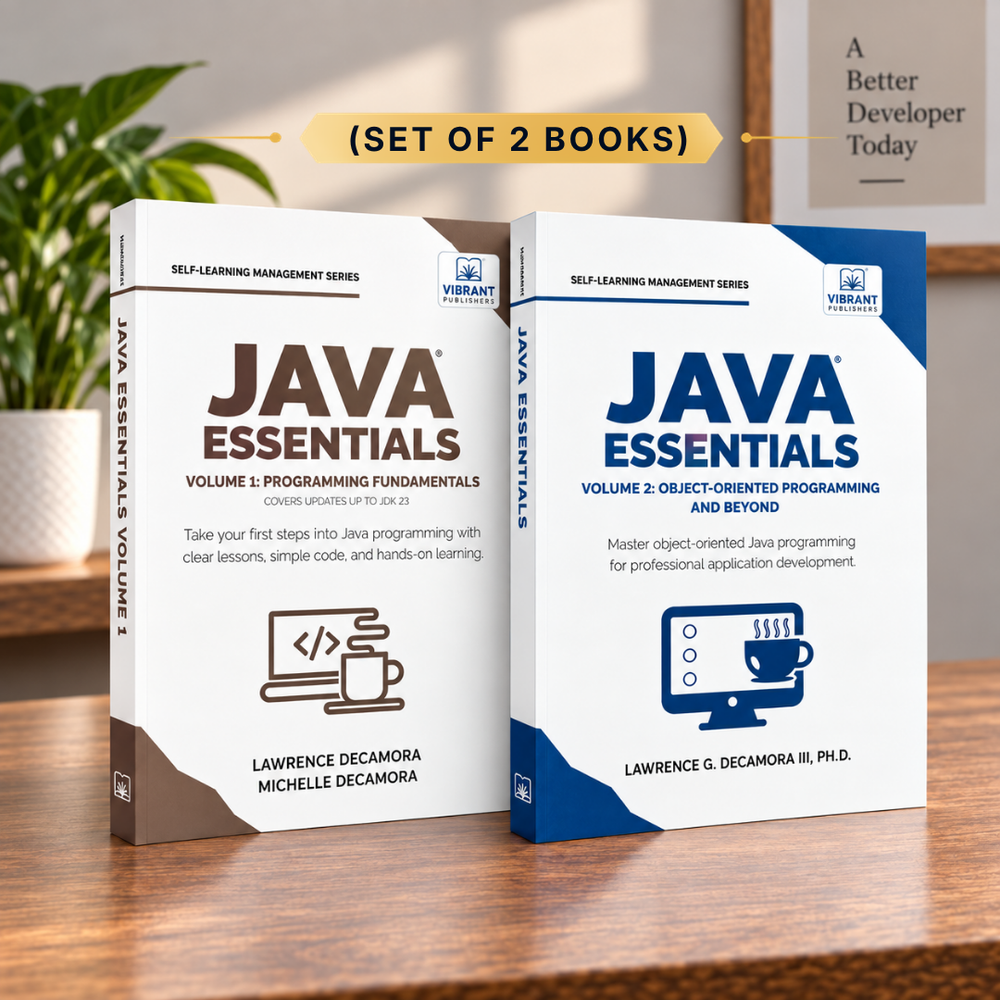
Java Essentials Vol 1 & 2: Programming Fundamentals, OOP, GUI Development, Data Structures, and Hands-On Coding for Beginners to Advanced Learners – Set of 2 Books
Request Sample Book / Online Resource
Enter your email and choose the resource type. We'll send access to your inbox.
Description
What’s Included in This Set:
Java Essentials Volume 1: Programming Fundamentals
- Introduces Java programming fundamentals, including variables, data types, control flow, methods, strings, and arrays
- Features beginner-friendly explanations, clean syntax, and hands-on coding exercises
- Helps readers build confidence in writing functional Java programs
Java Essentials Volume 2: Object-Oriented Programming and Beyond
- Covers object-oriented programming concepts such as classes, inheritance, polymorphism, and exception handling
- Includes GUI development using AWT and Swing with practical application examples
- Bridges foundational Java knowledge to real-world application development
Bibliographic Details
Pages: 772pages
Paperback (ISBN): 9781636516998
Category: Business & Economics
Author: Lawrence G. Decamora III, Vibrant Publisher
Table of Contents
Click on individual book titles below to view their complete Table of Contents.
Java Essentials Volume 2: Object-Oriented Programming and Beyond
Author
Lawrence G. Decamora III, Ph.D., is a certified Java expert (SCJP, OCPJP), educator, and industry professional with 20+ years of experience in academia and software development.
Vibrant Publishersis focused on presenting the best texts for learning about technology and business as well as books for test preparation. Categories include programming, operating systems and other texts focused on IT. In addition, a series of books helps professionals in their own disciplines learn the business skills needed in their professional growth.
Vibrant Publishershas a standardized test preparation series covering the GMAT, GRE and SAT, providing ample study and practice material in a simple and well organized format, helping students get closer to their dream universities.
Series
The Self-Learning Management Series is designed to help students, new managers, career switchers, and entrepreneurs learn essential management lessons and covers every aspect of business, from HR to Finance to Marketing to Operations across any and every industry. Each book includes basic fundamentals, important concepts, and standard and well-known principles as well as practical ways of application of the subject matter.
I am a lecturer in the Department of Computer Applications at a university in Coimbatore and have been evaluating this two-volume set for potential adoption as the primary text for our first-year Java programming course. The editorial decision to split Volume 1 - fundamentals - from Volume 2 - OOP and advanced application development - is not merely a publishing choice but a genuinely pedagogical one that mirrors how effective programming instruction should progress. Volume 1's careful coverage of identifiers, keywords, coding conventions, primitive data types, the Math class, the Scanner class, control structures, and two-dimensional arrays gives students a solid foundation that Volume 2 can assume without repeating. Volume 2's treatment of Collections, Generics, exception handling, file I/O, and Swing-based GUI development is comprehensive enough for a second-semester course without being overwhelming. The coding tasks throughout both volumes are well-designed for classroom assessment. An excellent two-volume academic resource for introductory Java instruction.
I teach computer science at a private engineering college in Raleigh, North Carolina, and have been searching for a Java beginner resource that sequences fundamentals and OOP into genuinely distinct and well-paced learning stages. This two-volume set by Lawrence G. Decamora III - a SCJP and OCPJP-certified Java expert with 20-plus years in both academia and software development - and Michelle C. Decamora, an IBM Certified DB2 Associate IT educator, achieves that editorial objective more effectively than any competing title I have evaluated. Volume 1's coverage of JDK setup, Java program structure, primitive data types, operators, control flow, methods, string manipulation, and two-dimensional arrays is comprehensive without overwhelming beginners. Volume 2's treatment of inheritance, polymorphism, interfaces, the Collections and Generics Framework, exception handling, file I/O, and AWT/Swing GUI development builds on that foundation with the right level of challenge. The hands-on coding exercises embedded throughout both volumes are the most practically designed I have encountered in a beginner-level Java text.
I manage a software development bootcamp in Portland, Oregon, that has been preparing career switchers for junior developer roles for a decade. In all that time, finding a two-volume resource that covers Java fundamentals and OOP with consistently high teaching quality - while also including GUI development that distinguishes graduates in interviews - has been an ongoing challenge. This set by Dr. Lawrence Decamora and Michelle Decamora resolves that challenge definitively. Volume 1's patient progression from JDK setup through program structure, data types, control flow, string manipulation, and arrays builds genuine coding confidence without shortcuts. Volume 2's coverage of inheritance, polymorphism, the Collections and Generics Framework, exception handling, and Swing-based GUI development takes participants through the material our hiring partners consistently expect. The hands-on coding exercises embedded throughout both volumes are the feature our participants benefit from most - theory without practice produces graduates who cannot perform under interview conditions. A reliable, professionally authored set that is now our default Java curriculum resource.
I was an accounts manager at a company in Hyderabad with no programming background when I decided to transition into software development. Java was the most in-demand language at the companies I targeted, and this two-volume set was the resource that made self-study feasible. Volume 1 by the Decamoras starts from absolute zero - JDK installation across multiple operating systems, the HelloWorld program, and the Java Runtime Environment - and builds systematically through data types, operators, control flow, methods, and one and two-dimensional arrays with coding tasks that required genuine practice rather than passive reading. Volume 2 then took me through encapsulation, inheritance, polymorphism, the Collections Framework, exception handling, and file I/O in a sequence that felt like a natural continuation. The AWT and Swing GUI development chapters produced my first real visual application - a milestone that dramatically accelerated my confidence. Dr. Decamora's 20-plus years of combined academic and industry experience are evident in every code example's precision and relevance. I secured a junior Java position within five months.
I am a software engineer at a technology company in Ankara who was transitioning from Python development into Java-based enterprise work. While I was not a complete beginner, I needed a structured resource that covered Java fundamentals and OOP in a logically sequenced way without assuming prior Java knowledge. This two-volume set delivered exactly that. Volume 1's treatment of Java program structure, the Scanner class, primitive data types, the Math class, operators, and control structures is precise and well-calibrated for programmers switching languages as well as complete beginners. Volume 2's coverage of OOP concepts - encapsulation, inheritance, polymorphism, abstract classes, and interfaces - alongside the Collections and Generics Framework is among the most clearly organized treatments of these topics I have encountered. The AWT/Swing GUI development section introduced desktop application building skills I had not previously explored. I would recommend more advanced coding challenges at the end of OOP chapters, but the overall quality and depth across both volumes is consistently strong.
- 5 stars: 15 (60%)
- 4 stars: 10 (40%)
- 3 stars: 0 (0%)
- 2 stars: 0 (0%)
- 1 star: 0 (0%)
I am a software engineer at a technology company in Ankara who was transitioning from Python development into Java-based enterprise work. While I was not a complete beginner, I needed a structured resource that covered Java fundamentals and OOP in a logically sequenced way without assuming prior Java knowledge. This two-volume set delivered exactly that. Volume 1's treatment of Java program structure, the Scanner class, primitive data types, the Math class, operators, and control structures is precise and well-calibrated for programmers switching languages as well as complete beginners. Volume 2's coverage of OOP concepts - encapsulation, inheritance, polymorphism, abstract classes, and interfaces - alongside the Collections and Generics Framework is among the most clearly organized treatments of these topics I have encountered. The AWT/Swing GUI development section introduced desktop application building skills I had not previously explored. I would recommend more advanced coding challenges at the end of OOP chapters, but the overall quality and depth across both volumes is consistently strong.
I was an accounts manager at a company in Hyderabad with no programming background when I decided to transition into software development. Java was the most in-demand language at the companies I targeted, and this two-volume set was the resource that made self-study feasible. Volume 1 by the Decamoras starts from absolute zero - JDK installation across multiple operating systems, the HelloWorld program, and the Java Runtime Environment - and builds systematically through data types, operators, control flow, methods, and one and two-dimensional arrays with coding tasks that required genuine practice rather than passive reading. Volume 2 then took me through encapsulation, inheritance, polymorphism, the Collections Framework, exception handling, and file I/O in a sequence that felt like a natural continuation. The AWT and Swing GUI development chapters produced my first real visual application - a milestone that dramatically accelerated my confidence. Dr. Decamora's 20-plus years of combined academic and industry experience are evident in every code example's precision and relevance. I secured a junior Java position within five months.
I manage a software development bootcamp in Portland, Oregon, that has been preparing career switchers for junior developer roles for a decade. In all that time, finding a two-volume resource that covers Java fundamentals and OOP with consistently high teaching quality - while also including GUI development that distinguishes graduates in interviews - has been an ongoing challenge. This set by Dr. Lawrence Decamora and Michelle Decamora resolves that challenge definitively. Volume 1's patient progression from JDK setup through program structure, data types, control flow, string manipulation, and arrays builds genuine coding confidence without shortcuts. Volume 2's coverage of inheritance, polymorphism, the Collections and Generics Framework, exception handling, and Swing-based GUI development takes participants through the material our hiring partners consistently expect. The hands-on coding exercises embedded throughout both volumes are the feature our participants benefit from most - theory without practice produces graduates who cannot perform under interview conditions. A reliable, professionally authored set that is now our default Java curriculum resource.
I teach computer science at a private engineering college in Raleigh, North Carolina, and have been searching for a Java beginner resource that sequences fundamentals and OOP into genuinely distinct and well-paced learning stages. This two-volume set by Lawrence G. Decamora III - a SCJP and OCPJP-certified Java expert with 20-plus years in both academia and software development - and Michelle C. Decamora, an IBM Certified DB2 Associate IT educator, achieves that editorial objective more effectively than any competing title I have evaluated. Volume 1's coverage of JDK setup, Java program structure, primitive data types, operators, control flow, methods, string manipulation, and two-dimensional arrays is comprehensive without overwhelming beginners. Volume 2's treatment of inheritance, polymorphism, interfaces, the Collections and Generics Framework, exception handling, file I/O, and AWT/Swing GUI development builds on that foundation with the right level of challenge. The hands-on coding exercises embedded throughout both volumes are the most practically designed I have encountered in a beginner-level Java text.
I am a lecturer in the Department of Computer Applications at a university in Coimbatore and have been evaluating this two-volume set for potential adoption as the primary text for our first-year Java programming course. The editorial decision to split Volume 1 - fundamentals - from Volume 2 - OOP and advanced application development - is not merely a publishing choice but a genuinely pedagogical one that mirrors how effective programming instruction should progress. Volume 1's careful coverage of identifiers, keywords, coding conventions, primitive data types, the Math class, the Scanner class, control structures, and two-dimensional arrays gives students a solid foundation that Volume 2 can assume without repeating. Volume 2's treatment of Collections, Generics, exception handling, file I/O, and Swing-based GUI development is comprehensive enough for a second-semester course without being overwhelming. The coding tasks throughout both volumes are well-designed for classroom assessment. An excellent two-volume academic resource for introductory Java instruction.
I am a senior software engineer at a fintech company in Bengaluru who mentors junior developers and regularly recommends learning resources to team members who join with gaps in their Java fundamentals. This two-volume set has become my go-to recommendation for anyone starting Java from scratch. The decision to split fundamentals from OOP and advanced application development across two volumes is more than just a publishing choice - it gives learners a natural checkpoint to consolidate Volume 1 skills before tackling the more complex concepts in Volume 2. The Collections Framework, exception handling, and file I/O chapters in Volume 2 are written with the clarity and precision you expect from a SCJP and OCPJP-certified author with 20-plus years of experience. The GUI development section rounds out the set with practical application-building skills. A well-designed and highly recommended pair.
I am a junior software developer at a technology startup in Izmir who used this two-volume set to fill foundational gaps that my computer science degree had left in my Java knowledge. Volume 1 covers the fundamentals clearly and without unnecessary complexity - the chapter on methods, method overloading, and parameter passing is particularly well-organized. Volume 2's treatment of the Collections and Generics Framework was the most practically useful section for my day-to-day work, and the Swing-based GUI development chapters introduced me to building desktop interfaces in a way that my university courses had never covered. Dr. Decamora's two decades of combined academic and industry experience shape the precision and relevance of the code examples throughout both volumes. I would appreciate more advanced exercises at the end of the OOP chapters, but the overall quality is consistently high.
I teach introductory programming at a state university in Columbus, Ohio, and have adopted this two-volume set as the primary text for our first-year Java course. What makes it stand out from competing titles is how carefully the two volumes are sequenced relative to each other. Volume 1 by Lawrence and Michelle Decamora covers JDK installation, program structure, data types, operators, control flow, methods, and arrays in a beginner-friendly progression that respects the actual cognitive load of new programmers. Volume 2 then picks up seamlessly with inheritance, polymorphism, interfaces, the Collections and Generics Framework, exception handling, file I/O, and AWT/Swing GUI development. Dr. Decamora's SCJP and OCPJP certifications and 20-plus years in both academia and software development are reflected in the technical precision throughout. A reliable, professionally authored two-volume curriculum resource.
I operate a software development bootcamp in Denver focused on preparing participants for entry-level Java developer roles within six months. Finding a two-volume resource that covers the complete beginner-to-OOP-and-GUI journey with consistently high teaching quality has been a persistent challenge. This set by Dr. Lawrence Decamora and Michelle Decamora solves that problem. Volume 1's step-by-step coverage of Java fundamentals - from JDK setup through two-dimensional arrays - is exactly what our participants need in the first eight weeks. Volume 2's treatment of inheritance, polymorphism, interfaces, the Collections Framework, and AWT/Swing GUI development takes them through the remaining curriculum with the right level of depth. The hands-on coding exercises embedded throughout both volumes are the most important feature for a bootcamp setting - theory without practice produces graduates who cannot perform under interview conditions. An outstanding set.
I am a commerce graduate from Ahmedabad who decided to transition into software development after spending four years in an accounting role. I had no programming background and was genuinely intimidated by the idea of learning Java from scratch. This two-volume set made that journey achievable. Volume 1 by the Decamoras starts at the very beginning - JDK setup, program structure, basic syntax - and builds through variables, control flow, and arrays with coding tasks that made me practice rather than just read. Volume 2 introduced OOP concepts including encapsulation, inheritance, polymorphism, and interfaces in a way that felt like a natural continuation rather than a jarring jump in difficulty. The GUI development section using AWT and Swing was an unexpected highlight - seeing a visual application I built myself was tremendously motivating. A genuinely life-changing set for career switchers.
I manage a small software training company in Austin and have been looking for a Java resource that allows learners to pace themselves without feeling overwhelmed. This two-volume set by Dr. Lawrence Decamora and Michelle Decamora solves that problem elegantly. Splitting fundamentals from OOP and application development is a smart editorial decision - students can build real confidence with Volume 1 before tackling the more complex concepts in Volume 2, including the Collections framework and AWT/Swing GUI development. The hands-on coding exercises throughout both volumes are practical and well-calibrated for the beginner level. A solid, professionally authored set that I now recommend as the primary resource for our Java foundation modules.
I am a career switcher who was transitioning from a banking operations role to software development in Bengaluru. This two-volume Java set was the primary resource I used for self-study over four months. Volume 1's beginner-friendly treatment of strings, arrays, and control flow helped me build a genuine foundation rather than just surface-level familiarity. Volume 2 then took me through inheritance, polymorphism, interfaces, file I/O, and exception handling in a way that directly prepared me for technical interviews. Dr. Decamora's 20-plus years in both academia and software development give the content a practitioner's authority that many self-study books lack. I secured a junior Java role within six months of starting this set.
I am a software engineering graduate student at a university in Chennai and picked up this set to strengthen my foundational Java skills before my internship. Volume 1 by Lawrence and Michelle Decamora covers everything from installing the JDK through two-dimensional arrays in a way that never assumes prior programming knowledge - the chapter summaries and coding tasks are excellent study tools. Volume 2's treatment of inheritance, polymorphism, and exception handling builds directly on that foundation, and the GUI development section using AWT and Swing gave me hands-on experience that most beginner books skip entirely. Dr. Decamora's credentials as a certified Java expert are evident throughout in the precision and clarity of the code examples.
I am a software developer transitioning into Java development from a Python background in Ankara, and this two-volume set was exactly the structured resource I needed. Volume 1 moves at a comfortable pace through Java fundamentals - data types, operators, control flow, and methods - with syntax explanations that are clear even for someone already familiar with programming concepts in another language. Volume 2's coverage of the Collections and Generics Framework and the Swing-based GUI development section are highlights that go beyond what most introductory Java texts offer. My one suggestion would be additional exercises at the end of the OOP chapters, but overall the quality and depth are commendable.
I teach introductory programming at a community college in Portland and have evaluated dozens of Java textbooks over the years. This two-volume set by Lawrence G. Decamora III - a SCJP- and OCPJP-certified Java expert with 20-plus years in academia and software development - stands out for how carefully it respects the actual learning curve of beginners. Volume 1 builds from JDK setup through variables, control flow, methods, and arrays with genuinely clean syntax and well-designed coding tasks. Volume 2's progression from OOP fundamentals through Collections, Generics, and AWT/Swing GUI development is one of the most logically sequenced I have seen at this level. An excellent adoption choice for introductory Java courses.
I learned Java through a disorganized mix of YouTube tutorials, Stack Overflow, and outdated university slides. When I found this set, I read both volumes cover to cover to fill the gaps - and discovered I had significant misunderstandings in areas like exception handling, polymorphism, and how interfaces interact with inheritance. Volume 1 clarified the fundamentals I thought I already knew. Volume 2 rebuilt my understanding of OOP from the ground up with the kind of systematic, progressive approach that self-teaching never provided. The real-world application examples and professional coding standards in Volume 2 are particularly strong. This is now my go-to recommendation for anyone starting Java.
Most beginner Java books stop at OOP concepts and leave you wondering how to actually build something a user can interact with. Volume 2 of this set goes further - the AWT and Swing sections with practical desktop application examples gave me my first experience of building a real GUI program in Java. The event handling coverage in particular was something I'd been struggling to learn from online tutorials. Volume 1 laid the foundation cleanly across variables, operators, and arrays, and Volume 2 delivered on the promise of taking that foundation to a real application development level. The Collections and Generics Framework section was also a strong addition.
I spent twelve years in accounting before deciding to transition into software development. Java was the language my bootcamp required, and I needed supplementary material that moved at a pace I could follow outside of class hours. Volume 1 was perfect for that - the JDK setup walkthrough alone saved me hours of frustration, and the step-by-step coverage of control flow and methods gave me a structured self-study path alongside the bootcamp curriculum. Volume 2 took me into OOP territory that the bootcamp covered quickly, and reading it at my own pace helped me truly internalize inheritance, polymorphism, and GUI development rather than just memorizing syntax. A 4 because a few more worked examples in the file I/O section would have helped me, but both books are excellent value.
I teach an introductory programming course at a technical college and adopted this two-volume set as the primary textbook for the semester. The results have been the best I've seen since I started teaching the course. Volume 1's structured coverage of variables, control flow, methods, and arrays gave students a solid foundation with clear syntax examples and meaningful coding tasks at each chapter end. Volume 2 then carried them into OOP, inheritance, polymorphism, and file I/O in a way that felt like a natural continuation rather than a jarring leap in difficulty. The chapter summaries and quiz questions across both books are excellent for assessment design. A 4 because I'd have liked slightly more exercises in the Generics section, but overall an outstanding teaching resource.
I tried three different Java books before this set and kept hitting the same problem - they either rushed past the fundamentals or jumped into OOP before I was ready. This two-volume structure solves that completely. Volume 1 takes you from JDK setup through variables, control flow, methods, strings, and arrays at exactly the right pace, with hands-on coding exercises that actually reinforce what you've just read. Volume 2 then picks up naturally with classes, inheritance, polymorphism, exception handling, and GUI development using AWT and Swing - concepts that build directly on everything Volume 1 established. Dr. Decamora's 20-plus years of teaching and Java expertise are evident throughout in how clearly the pedagogy is sequenced.

Contact Information
Got questions? Call us on
+1-720-986-5272
Need help with your order?
reachus@vibrantpublishers.com
Available 24/7 via whatsapp chat
+1-315-413-6418
*Test names are the registered trademarks of their respective owners, who are not affiliated with Vibrant Publishers.
© 2026,
Vibrant Publishers LLC.